




What we cover

Most loyalty programs are designed for the customer who already loves the brand. The reality is that most members who sign up are customers who like a lot of brands.
And once they're in, those members behave nothing alike either.
Across fuel, grocery, and restaurant, members in the same program respond very differently to the same offer. Some chase every promo. Some redeem once and never again. Some show up regardless. Most loyalty teams are still designing for an aggregate. One member. One average. One playbook.
No actual customer fits the average.
Upside's multi-vertical loyalty study surveyed roughly 3,400 U.S. consumers and scored each one on two dimensions: how price sensitive they are, and how strong their brand affinity is. Plotted on a 2x2, four distinct customer types emerge. Three of the four are uncommitted. Only one is actually loyal.
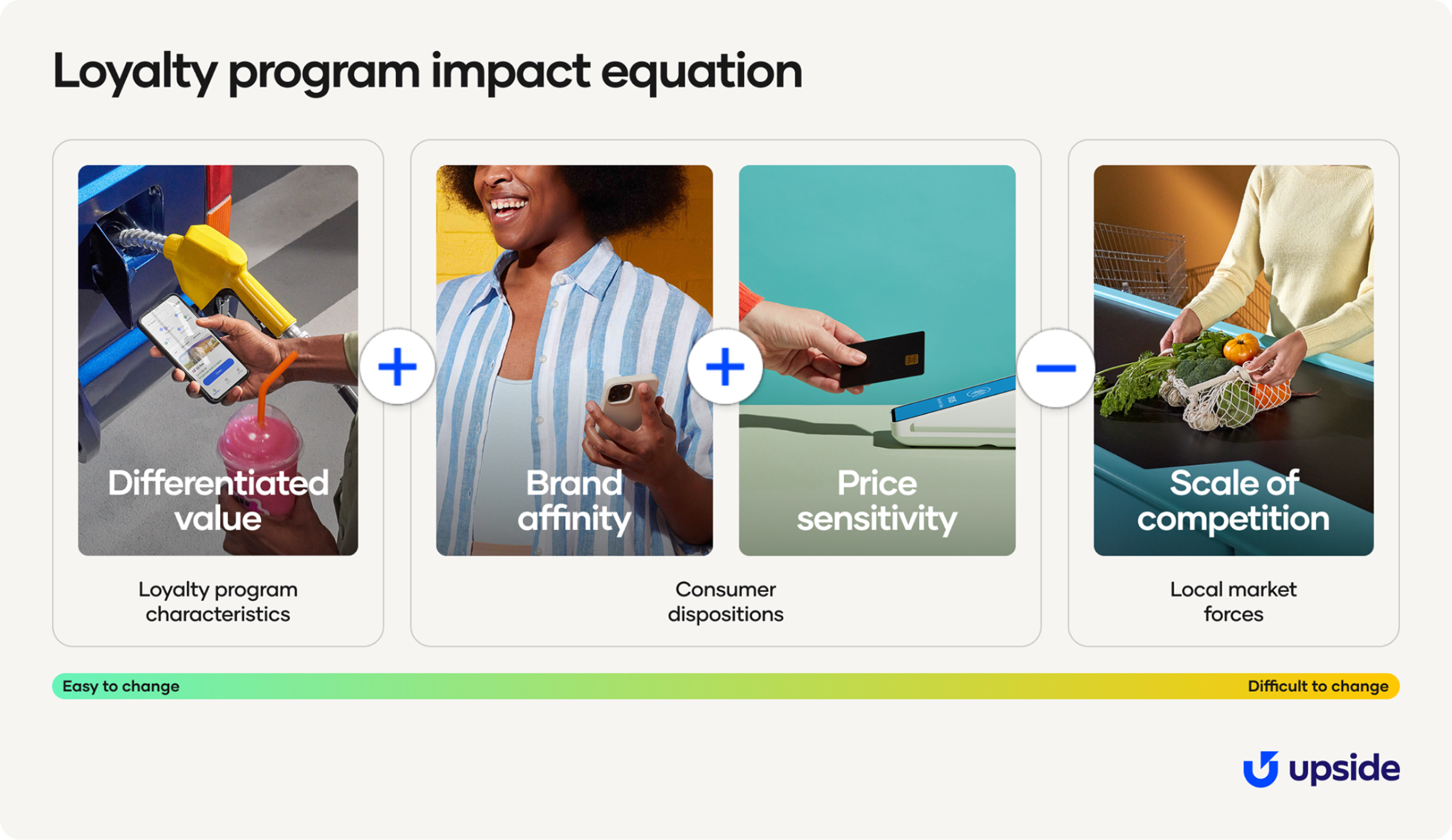
Several factors determine the effectiveness of a retailer’s loyalty program:
Four customers, three uncommitted
Each type appears consistently across fuel, grocery, and restaurant. Each behaves very differently inside the loyalty programs they join.
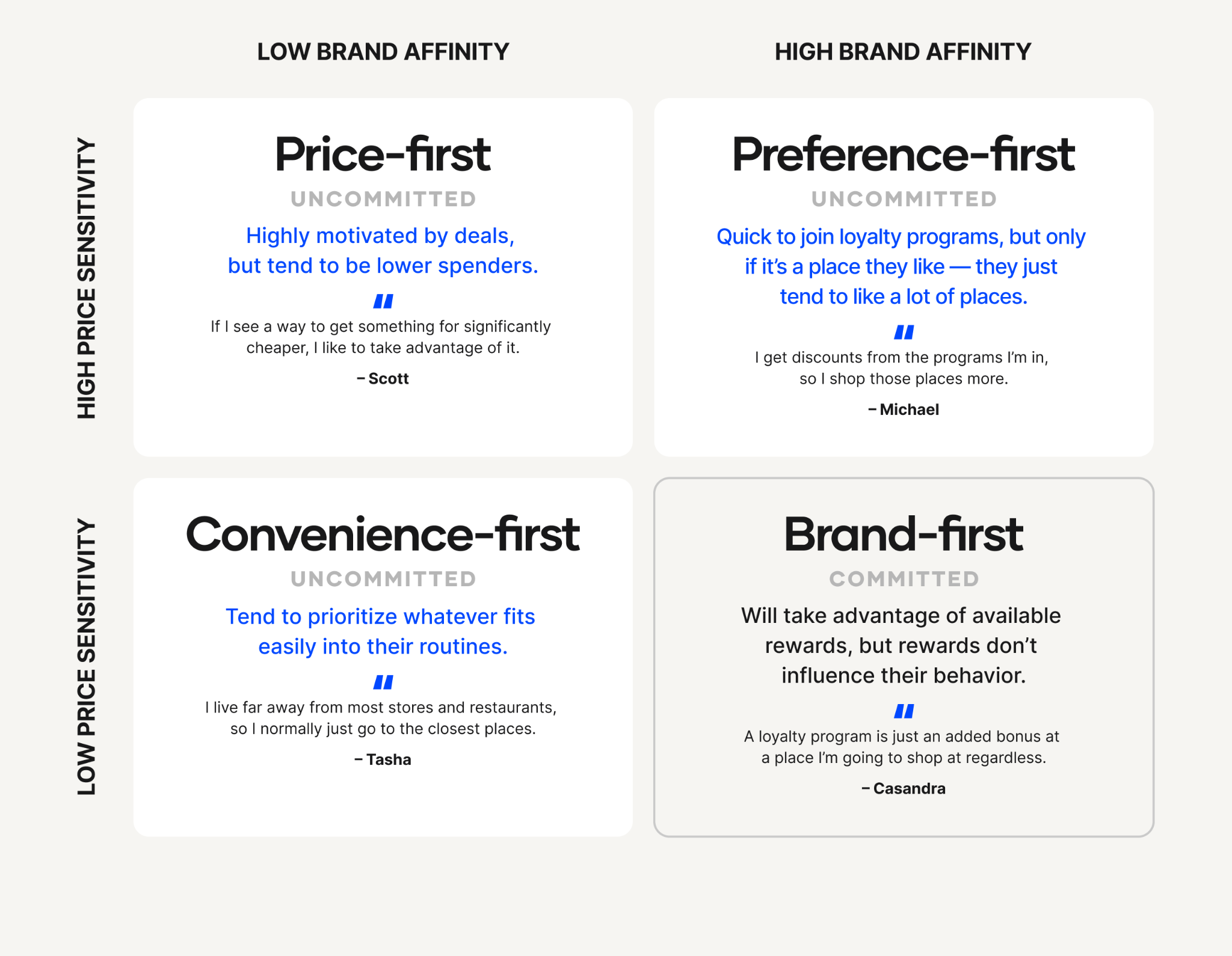
Three of these customer types are uncommitted. That tracks with prior research showing roughly 80% of consumers are uncommitted to any single retailer.
The most movable customer is the opportunity to focus on
Loyalty teams typically assume their best opportunity is to deepen the relationship with the brand-first crowd. They're already devoted. Reward them, and they'll behave even more loyally.
The data tells a different story. In every category studied, brand-first consumers were not the most likely to join. They're already going to shop the brand. The program adds a reward to behavior that was already happening.
The most readily influenced consumers are the preference-first segment, which also happens to be the largest. They're price aware enough to respond to incentive structures, and brand-aware enough to develop real affection for retailers who treat them well. The data has a name for this group: the persuadable middle. They're the segment with the most behavior left to shape, and the segment most likely to join a program in the first place.
If your program isn't built to move this customer, the biggest opportunity in the category is still wide open.
Designing for the average means designing for no one
A program built for the average member is, in practice, a program built for none of these four customers in particular:
- Brand-first members don't need persuasion.
- Convenience-first members aren't moved by rewards in the first place.
- Price-first members will leave the moment a cheaper offer crosses their path.
- Preference-first members (the largest and most influenceable segment) are being treated as part of an undifferentiated mass.
These customers behave very differently and require different approaches. Designing the program as if they were the same is part of why loyalty programs across the category feel like they're working harder for less return.
Most programs are still optimizing for an average that doesn't exist. Across fuel, grocery, and restaurant, the customer ready to be moved is sitting untouched. The first retailer to build for them wins the segment in their category.
Which of these four customers is your program actually built for?
Get your copy of Escaping the Loyalty Plateau
Upside's 2026 research report explores why most loyalty programs plateau and why preference-first consumers represent the biggest opportunity.




Request a demo
Request a demo of our platform with no obligation. Our team of industry experts will reach out to learn more about your unique business needs.


