




What we cover

After months of war that created tension across the world, the United States and Iran signed a memorandum of understanding in Islamabad to cease fighting and allow oil tankers to pass through the Strait of Hormuz.
This isn’t a permanent solution, as it only calls for a 60-day ceasefire. And even that has been fragile, with sparks of conflict continuing during the cessation. But the framework for a diplomatic off-ramp is there, and negotiations are ongoing.
The oil market responded favorably to the news of the agreement, with significant downswings over the course of June. Consumers responded in kind, shifting out of the “survival mode” behavior they adopted during the supply crisis and resuming some of their old habits.
We’ll break down the full month in fuel here.
Last month’s data
Re-opening the Strait delivers significant price relief
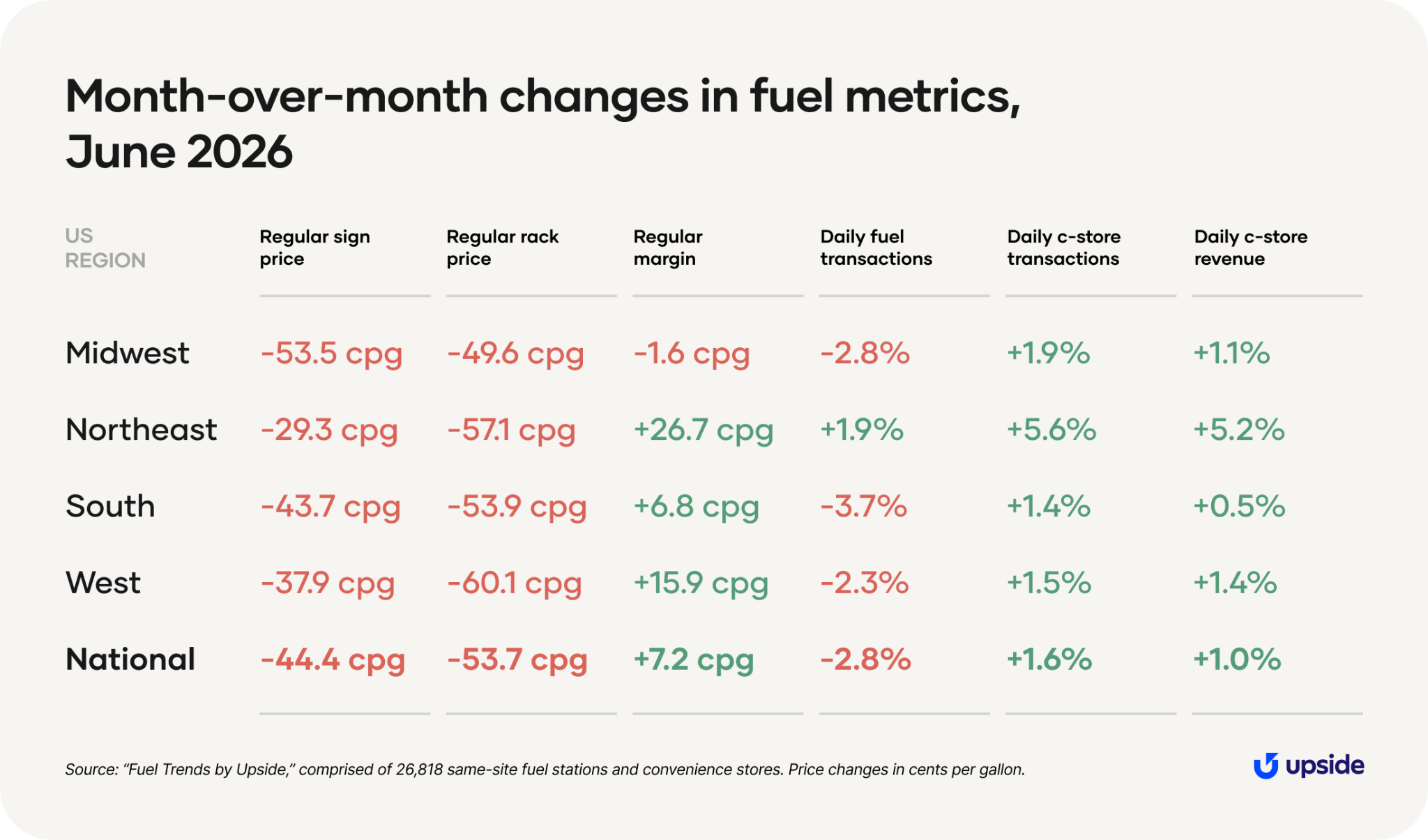
At the beginning of June, West Texas Intermediate (WTI) oil was selling for about $89 per barrel. It dropped 21% over the course of the month, and coupled with higher optimism, we’re now seeing lower fuel prices across America.
The typical U.S. station paid about 54 cents less for a gallon of regular compared to May. Consumers, too, saw significant relief. Sign prices fell about 45 cents a gallon, and the national average now sits solidly below that important $4 per gallon threshold.
As is typical (and temporary) when gas prices are falling, rack prices lowered more quickly than sign prices. This resulted in an increase of 7 cents per gallon in regular margins at the typical station. We don’t expect this trend to last too long, though — regular margins began dropping in the latter half of June as competition exerted downward pressure on sign prices.
Back in March, we covered how consumer behavior had changed amid high gas prices. At that time, our data showed the following:
- Consumers were visiting the gas station more often.
- But with each visit, they were buying fewer gallons per trip.
- Consumers who previously purchased midgrade or premium fuel were trading down.
With prices dropping precipitously in June, we see that many drivers are now resuming their old habits. Consumers responded to lower sign prices by buying more fuel, with the average US station selling about 2% more gallons per day and about 5% more gallons per transaction month-over-month. That’s a big part of the reason we see a drop in fuel visits in the chart above. That “more trips, less gallons” behavior shift has begun to subside, and more consumers are now filling their tanks in one go.
You might also notice that the Northeast seems to buck many national trends this month. Fuel margins increased disproportionately, fuel transactions did not decrease, and c-stores saw disproportionate lifts in both transactions and revenue. Looking back at June 2025, we actually saw a similar idiosyncratic lift for the region, indicating there may be some strong seasonal effects at play for this part of the country.
The main focus of our recap this month, though, will be how consumers are taking advantage of cheaper gasoline. Let’s dig deeper.
Consumer behavior snaps back — bigger fill-ups, more premium
Amid lower sign prices, consumer fuel habits are getting back on track — and most importantly for retailers, we already see signs that overall demand is beginning to recover.
Again, the average American station sold about 2% more gallons per day in June than they did in May. For retailers, this is especially meaningful because demand was essentially flat from April to May. In previous years, we’ve observed strong seasonal boosts at that time of year.
While this is all welcome news for gas stations, it doesn’t completely undo the impact of war in Iran. There is still more recovery to reach the volume levels of 2024 or 2025.

Volume is ticking up in part because consumers are starting to buy more gas with each visit.
Early in the year, a driver at the average US gas station would buy 10.8 gallons of regular grade gasoline. But as prices started to rise in March, drivers filled their tanks a little bit less with each visit to the pump. During the peak of high prices in May, the average consumer was only buying 9.6 gallons of regular per visit.
Conversely, as prices began to decline in June, volume per transaction began climbing. By the last week of the month, a driver at the average US station was purchasing above 10 gallons of regular per visit. This is still below the levels seen in February 2026; however, it continues to trend up.

Finally, we are also beginning to see a recovery in higher grades of gasoline.
At the height of the supply crisis, many drivers who previously purchased midgrade or premium fuel were taking a step down to regular in order to save money. With fuel now costing less, those high-grade buyers are returning. As you can see below, the war created the volume gap between regular and high-grade fuels, but that gap is closing fast.

Predictions and considerations
What will hold, and what will change?
As we look ahead to July, it remains to be seen which trends will hold. Will the United States and Iran come to a long-term agreement for peace? Will oil and fuel prices continue to fall? Will consumers stay on a path towards their pre-war buying levels?
The answer to that first question probably underpins any other one. Peace will be necessary to keep the Strait of Hormuz open, which will be necessary to keep prices down, and so on.
Shortly before publication, President Trump cast doubt on an extension of the ceasefire, stating that he thinks it is “over.” The United States and Iran have continued their attacks into July, and the balance in the region appears tenuous, to say the least. We’re hoping cooler heads prevail to extend the ceasefire and keep the Strait open.
Potential tailwinds:
1. OPEC+ announced new supply increases at the beginning of July. Now that the Strait of Hormuz is re-opened, this proclamation has more sway than other recent ones. A number of member nations, including Saudi Arabia, Iran, and Iraq, send oil tankers through the Strait.
2. Summer driving season is in full swing, and the roads are crowded with both commuters and vacationers. We expect elevated demand for the remainder of the season.
Potential headwinds:
1. The supply problem is certainly better than it used to be, but it’s not fully fixed. Ship traffic through the Strait is still below pre-war levels. Many nations like the United States have depleted their strategic reserves. It will take a while before we can say everything is fully back to normal.
2. We’re entering month two of hurricane season. It’s projected to be a slow one, but things can change quickly. Any significant weather disruptions could greatly impact the fuel market in that region.
Subscribe for monthly trend updates
Check out our insights hub with all our fuel and convenience monthly updates, or fill out the form below to subscribe to monthly fuel and c-store insights.




Request a demo
Request a demo of our platform with no obligation. Our team of industry experts will reach out to learn more about your unique business needs.


