




What we cover

Most fuel and convenience retailers would consider a loyalty member “their” customer, no questions. But hardly any consumers stop at just one program membership — and as enrollment keeps climbing, the strength of any one program slips.
None of this means loyalty has stopped working. A program that earns the next trip is as valuable as ever. But since every brand now offers a similar-looking program (an app, rewards, cents-off), a growing member base doesn’t say much about who's actually being won.
That's the central finding of Escaping the Loyalty Plateau, our new report based on surveys from 12,000 consumers and retailers across the fuel, grocery, and restaurant industries. The report explores the concerning gap between enrollment and influence and offers retailers solutions to maximize their investments.
Signing shoppers up has become the easy part; earning their influence is where the next era of fuel loyalty gets won.
The sign-ups keep coming, but loyalty doesn't follow
People love loyalty programs, and the research is clear on it. Nine in 10 consumers say loyalty is important to them.
Because consumers are enthusiastic about loyalty, retailers are right to provide it. But that leaves us with intense program saturation in the fuel and convenience category, and consumers are responding to the wide variety of choices by signing up for multiple programs. For fuel and c-store retailers, your average loyalty member belongs to 2.3 other programs in this category alone.
Zoom out and the pattern holds. For consumers, uncommitment is now the norm. Nearly 75% of fuel and c-store consumers exhibit uncommitted behavior, spreading around their trips to prioritize their own value ahead of brand loyalty. They’re using branded fuel cards less, and they’re joining multiple loyalty programs.
Over the past decade, loyalty memberships across retail have grown about 60%, while active memberships have grown only 8%, according to the Bond Loyalty Report. Retailers got very good at capturing a phone number or an app download at the register. Turning that into tangible behavior change has been the harder part.
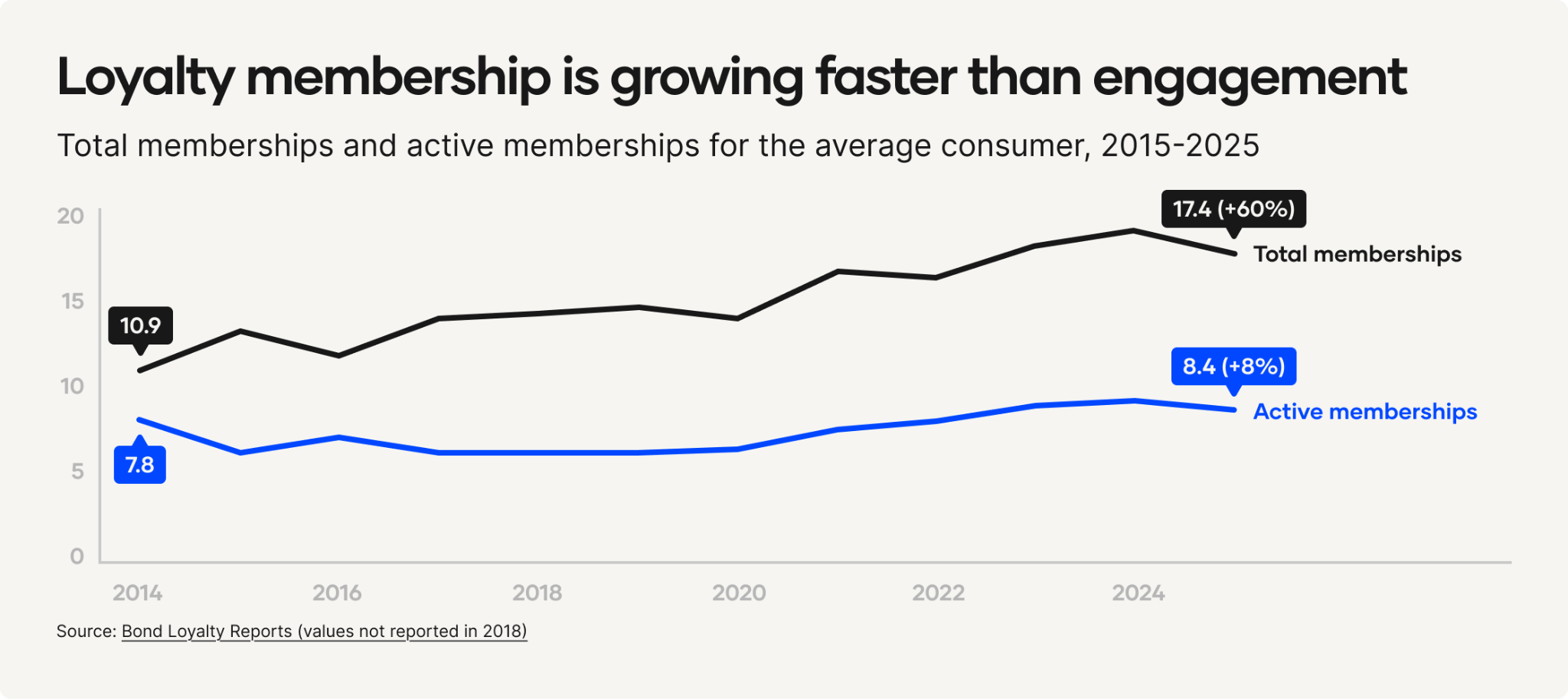
We’ve called that the loyalty plateau — the stage of program maturity where sign-ups keep climbing even as the program's pull on behavior softens.
Loyal on paper, up for grabs at the pump
It might surprise fuel retailers, but our research shows that it’s true: a lot of your loyalty members have trips that are completely up for grabs.
They tap the app at the pump this week, fill up across town next week, and pull into a third brand on a road trip, following whichever price, location, or offer wins the moment. A loyalty program rewarded every one of those fill-ups, but its impact on decision-making is questionable.
Upside's research maps where fuel loyalty has pull and where it runs thin. We learned that fuel and c-store programs are moderately effective overall; they’re best at increasing trip frequency and prompting members to make referrals. On the other hand, fuel loyalty’s weakest spots are the ones that actually grow the business: total spend, real exclusivity, and keeping members from filling up everywhere else.
That's the difference between enrollment and influence.
How fuel programs break the plateau
A loyalty plateau has exposed a gap that marketplaces — third-party platforms where consumers already spend time — can fill. These marketplaces put fuel brands in front of the uncommitted shopper at the exact moment when they're choosing where to stop. A loyalty program almost never gets to influence that moment. It rewards the fill-up after a driver has already pulled in, while a marketplace shows up before the next trip has been undecided.
Marketplaces don’t replace loyalty programming, though — the two work best together. Loyalty is an effective retention tool for customers already in the retailer’s ecosystem, while marketplaces expand reach to those harder-to-reach new and lapsed customers.
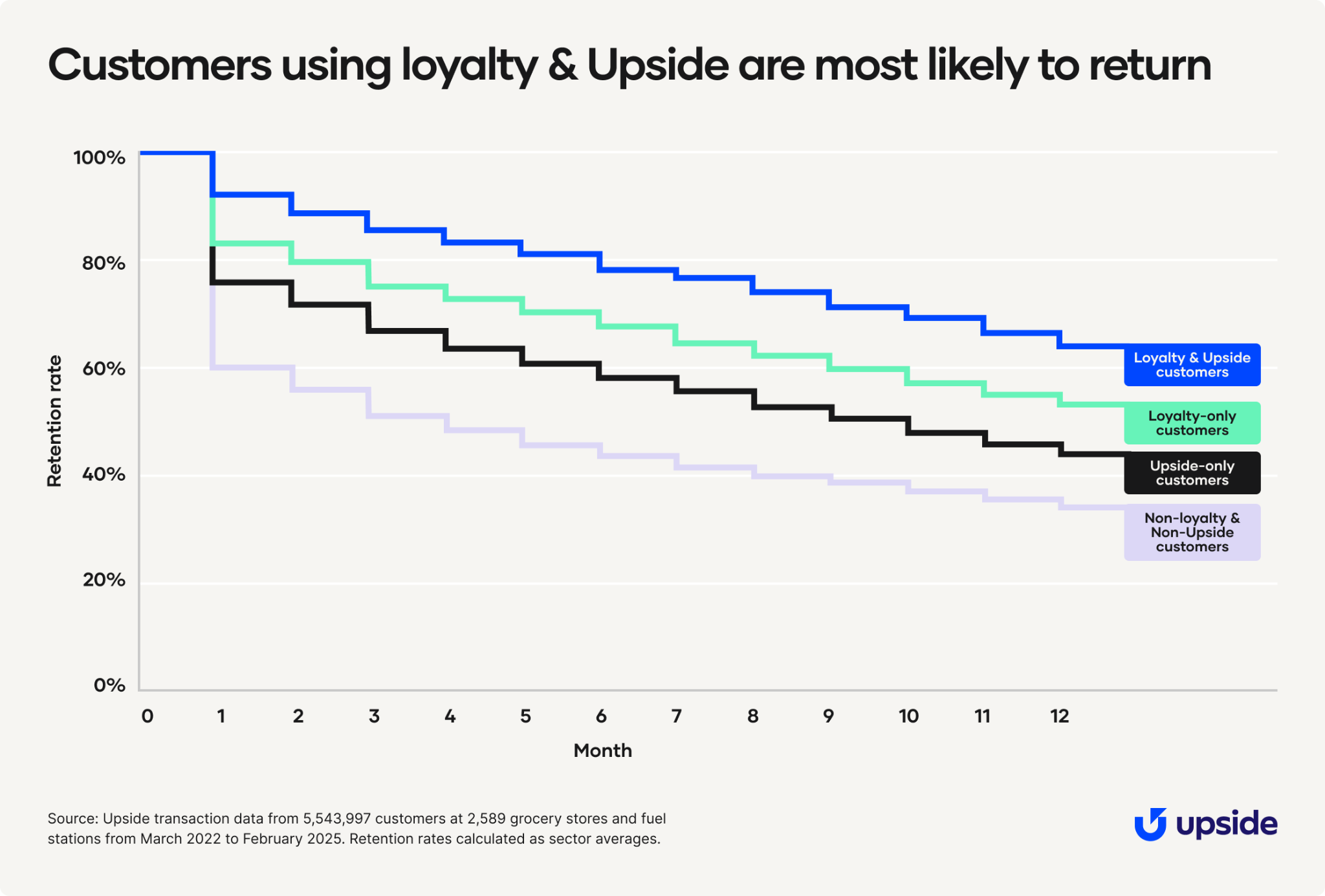
Upside is one such marketplace, and the retention data shows what happens when it runs side by side with loyalty. Across billions of transactions, retailers on Upside hold onto customers better than those running a loyalty program alone. Loyalty and Upside each cut churn independently, but they’re most effective together — cutting customers’ first-month churn by more than 30 percentage points.
From enrolled to chosen
Breaking the plateau has nothing to do with the size of the member list and everything to do with how many of those members a program can actually move. For a fuel brand, a marketplace is how the hardest ones get reached.
The retailers pulling ahead have already changed the question they ask, from how many drivers joined to how many they moved, and that's what turns an enrolled member into a driver who pulls in on purpose.
Escaping the Loyalty Plateau lays out the full picture for fuel and c-store, including the influence data behind the plateau and what differentiated value looks like in practice — read the full report.



Request a demo
Request a demo of our platform with no obligation. Our team of industry experts will reach out to learn more about your unique business needs.


