





What we cover

Most major loyalty programs in fuel, grocery, and restaurant have hit the same wall: sign-ups keep arriving, redemption holds, but the bottom-line impact lags.
That gap has a name. It's the loyalty plateau: the stage where program growth keeps coming but business impact stalls. Upside's 2026 study of more than 12,000 consumers and retailers found that most major programs in fuel & convenience, grocery, and restaurant have hit it.
The cause is structural: undifferentiated loyalty programs in a saturated category.
How loyalty became a participation game
For years, loyalty programs were judged by metrics that were easy to measure:
- Enrollments
- App downloads
- Active members
- Redemption rates
Those metrics made sense when loyalty was still relatively novel. But as loyalty programs became standard across fuel, grocery, and restaurant, they stopped being reliable indicators of competitive advantage.
Today, consumers routinely belong to multiple programs within the same category. A fuel customer may belong to three or four rewards programs. A grocery shopper may scan different loyalty accounts throughout the week. Restaurant diners often collect rewards from several competing brands simultaneously.
As enrollment becomes universal, membership alone tells retailers less about whether they are influencing behavior. The question is no longer whether customers joined a program. It's whether the program changed what they would have done otherwise.
That transition — from participation metrics to influence metrics — is where many programs encounter the loyalty plateau.
More members deepens what the program already does. Growth past the loyalty plateau requires changing what the program does in the first place.
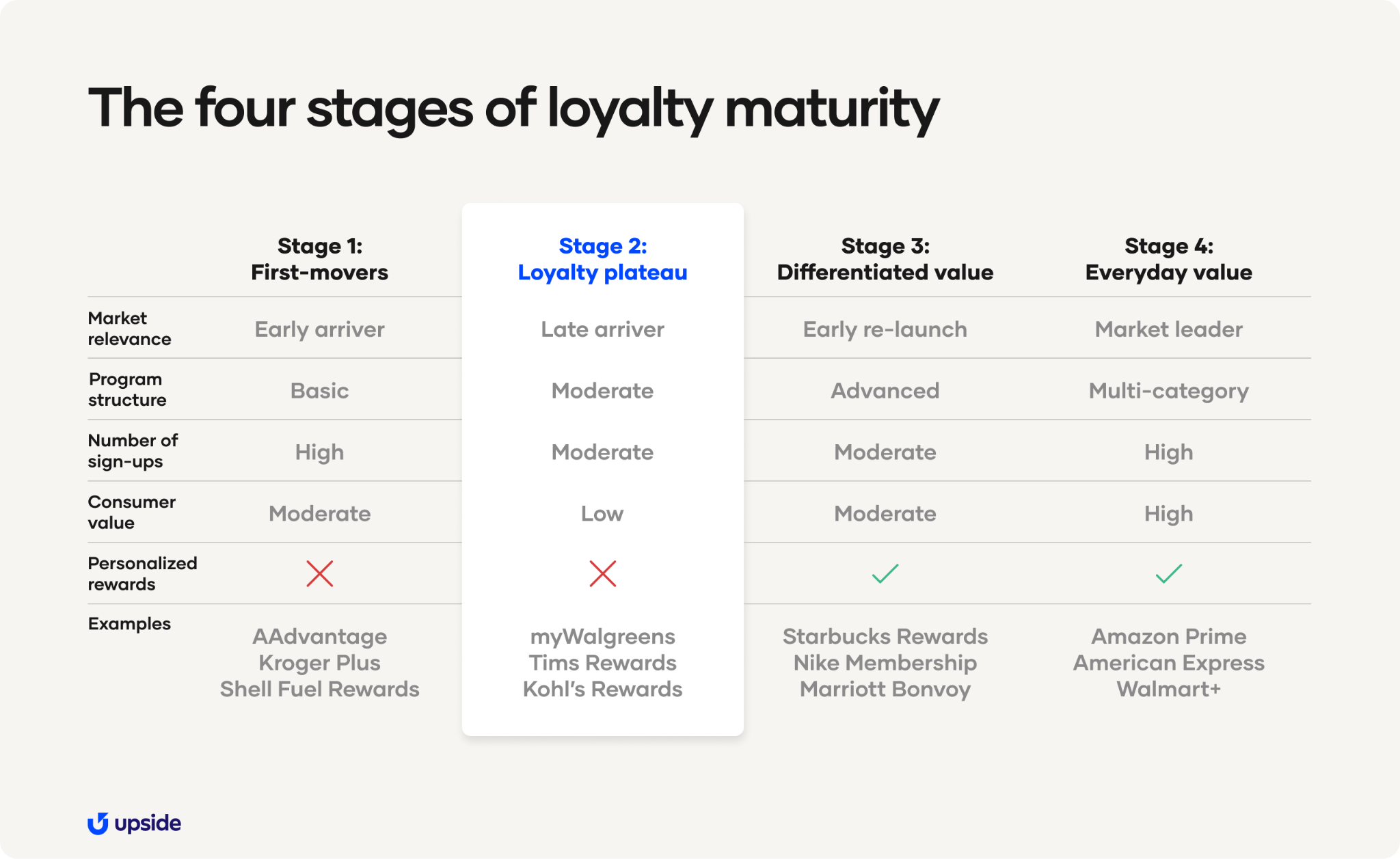
Behind the plateau: programs that fund discounts more than they build loyalty
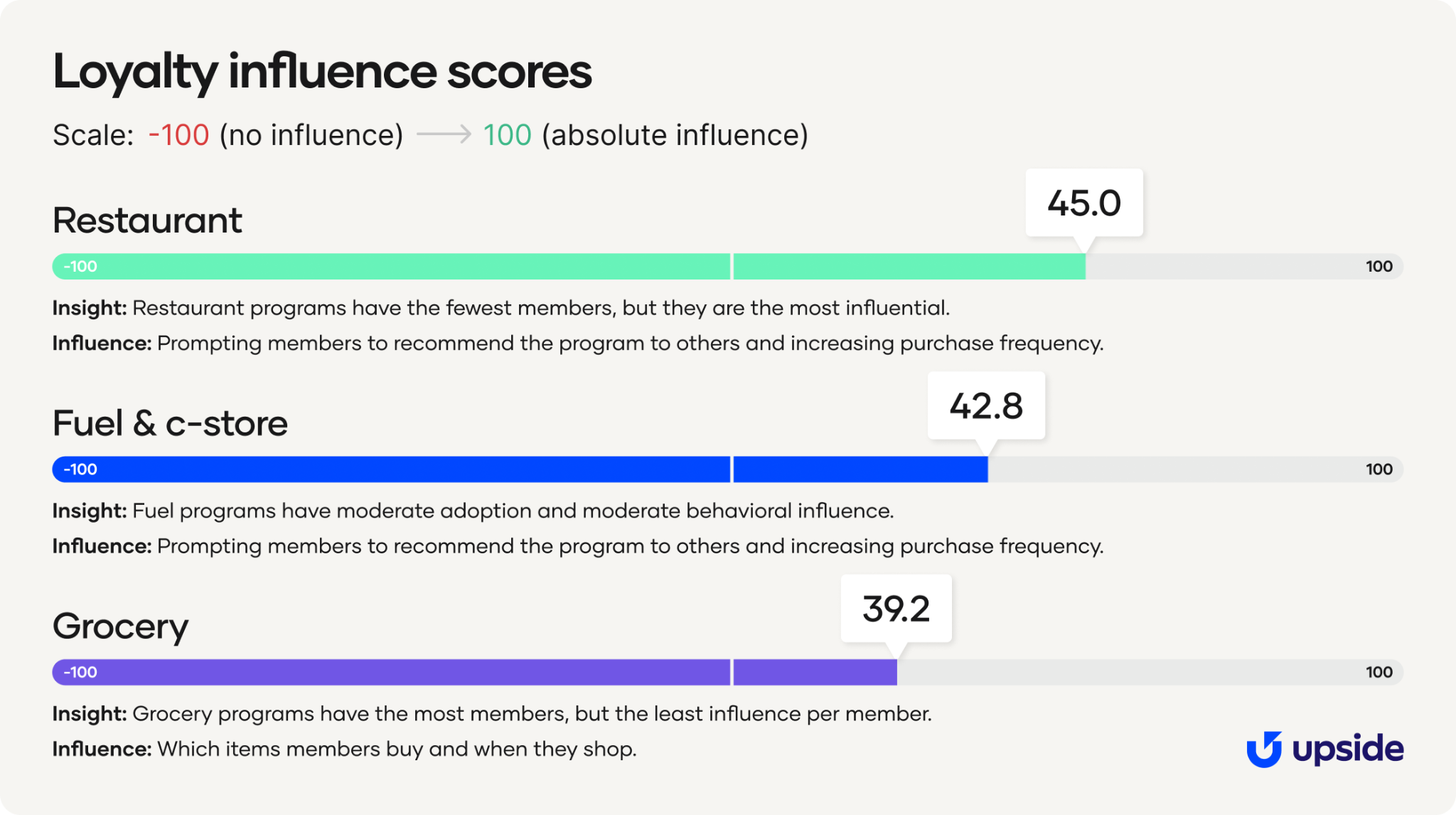
Loyalty influence score is a metric Upside built to measure how much a loyalty program changes consumer behavior. A high score (close to 100) means program members shift their behavior every time. A low score (close to –100) means members do what they would have done without the program. The major programs in fuel, grocery, and restaurant all landed in the moderate range:
- Restaurant: 45.0 out of 100
- Fuel: 42.8
- Grocery: 39.2
Most consumers in these categories are already enrolled in multiple competing programs. Where programs do move behavior, consistently across categories, is category share. Share gains are real value. They're also the dimension every competitor is working the same play to make.
Grocery
Grocery programs have the most members but the least influence per member. They tend to shape which items go in the cart and when they shop.
Fuel & convenience
Fuel programs have moderate adoption and moderate behavioral influence. Programs nudge members to recommend the program to others, and to visit more often.
Restaurant
Restaurant programs have the fewest members overall, but they are the most influential. They’re most effective at prompting members to recommend the loyalty program to others, and at increasing purchase frequency. However, when deciding where to eat, we know that taste and palate play an outsized role. For that reason, it’s fair to wonder whether restaurant loyalty programs are really changing behavior. Consumers might instead commit to their favorite spots for reasons unrelated to their loyalty program, though they’ll join the brand’s program if it’s offered.
The metric that doesn’t move
Across all three categories, total spending barely moves. Programs consolidate share within the category without growing it. The economic effect is closer to a funded discount for existing customers than the behavior shift programs were originally built to create. Ultimately, this is the primary problem with loyalty programs: Membership doesn’t necessarily indicate that the shopper is behaving any differently.
Why more members can't close the gap
More members won't close the gap. The plateau is where share-shifting tops out as a growth strategy.
Growing category share is a real short-term win. It's also a short-term win in a contest where every competitor is running the same playbook. The deeper measure of loyalty is whether members are becoming more loyal over time: visiting more often, spending more per trip, expanding what they buy. That measure can stay flat while the share number moves.
That deeper measure is total category spend. Across fuel, grocery, and restaurant, it's the dimension programs influence least. It's also where long-term loyalty actually shows up. Moving past the plateau means changing what the program is built to influence.
Programs that move beyond the plateau tend to share a common characteristic: they create differentiated value rather than simply offering another version of the same discount.
That doesn't necessarily mean larger rewards. It means creating reasons for consumers to change behavior:
- More relevant offers
- Personalized incentives
- Rewards tied to incremental behavior
- Experiences that competitors cannot easily replicate
The goal shifts from rewarding transactions to influencing decisions.
In a category where nearly everyone has a loyalty program, differentiation comes less from having a program and more from what the program persuades consumers to do.
Get your copy of Upside's research report, Escaping the Loyalty Plateau
Dig into the data on how programs reach the plateau, who the persuadable consumers are, and what differentiation looks like in practice.



Request a demo
Request a demo of our platform with no obligation. Our team of industry experts will reach out to learn more about your unique business needs.


