





What we cover

In May, the Strait of Hormuz was effectively closed, and fuel prices were still expensive. We passed 100 days of living this reality, and though the United States and Iran have just struck an agreement, it will still take months before gas prices finish settling to their pre-war levels.
But let's not get ahead of ourselves — let's focus on May's data. In this Fuel Trends update, our analysis focuses on the impacts of one solution that the federal government has raised to bring down gas prices: waiving its gasoline tax. Two American states have tried that tactic already, so we have data to make estimations about how a federal initiative would play out.
Read on for a full recap of May in fuel, with a look ahead towards June and the official start of summer.
Last month’s data
Prices remain high as summer driving season gets underway
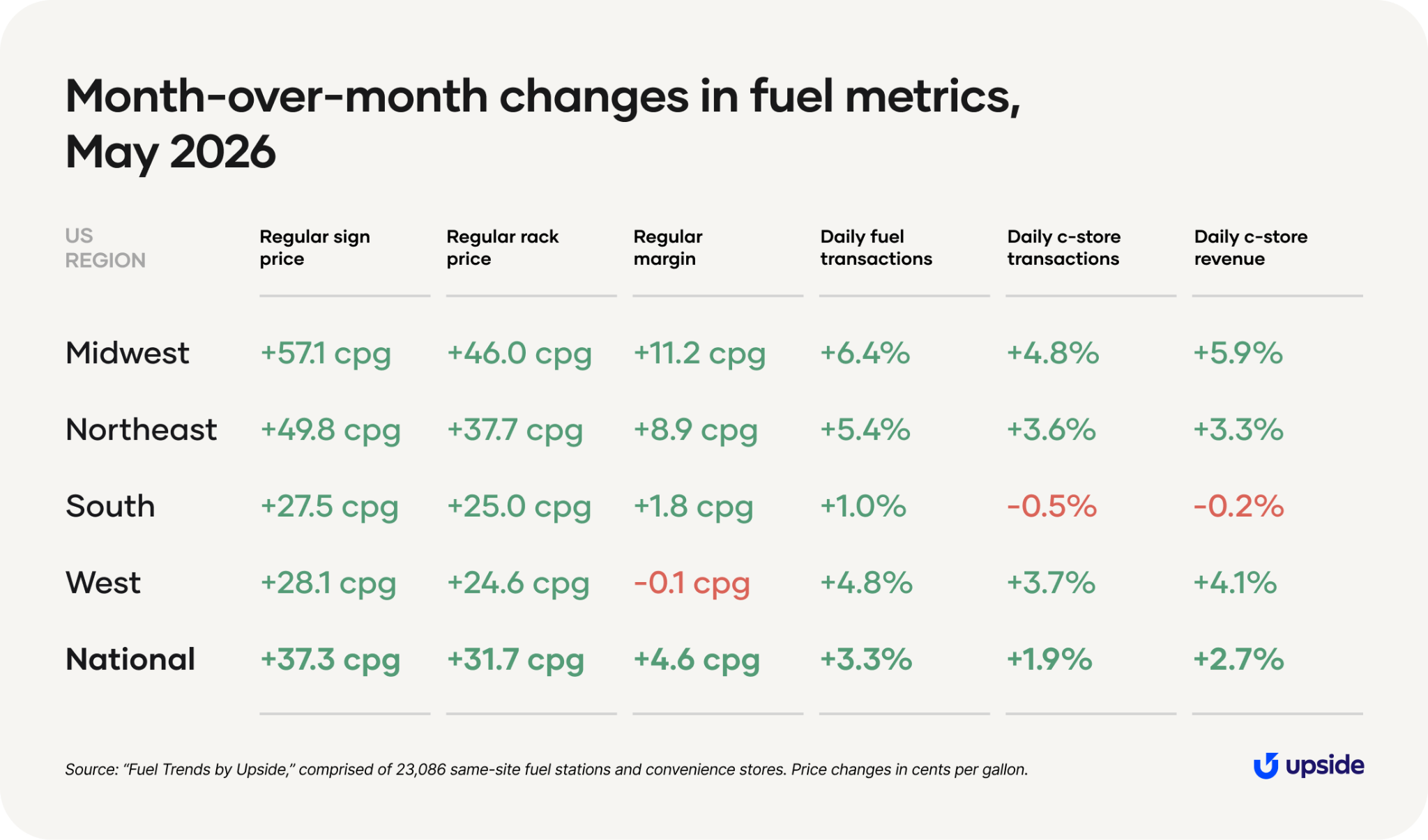
Across the country, both rack prices and sign prices increased considerably in May — with national averages for each up more than 30 cents per gallon.
While it may seem like stations in the Midwest and Northeast are profiting from the rise in pump prices with higher increases in their margins, this discrepancy is likely due to them making up for lower margins earlier in the year. Stations in those regions actually started the year with decreasing profit margin per gallon for three consecutive months.
On the demand side, transactions were up — and that is both in spite of and because of the high prices we’re seeing.
First, Memorial Day Weekend brings an annual peak for road travel, and this year was no exception. Even with high prices, people across America continue living their lives — going to work, taking trips, and so on.
But also, fuel transactions were up in May because of a behavior change that high prices have caused. As we covered last month, when sign prices are elevated, drivers tend to buy less each time they visit. And because they drive roughly the same amount, they require more visits overall.
Inside the c-store, visits followed a similar pattern, but not quite as pronounced as fuel, hinting at some softening of consumer demand despite typical seasonal increases.
Is a gas tax holiday the answer for high prices?
Amid the ongoing fuel supply crunch, leaders around the world have tried numerous tactics to bring prices down for their citizens. Many nations, including the U.S., have tapped into the strategic petroleum reserves to increase available gallons. Some countries, including Pakistan and the Philippines, have instituted a four-day work week to reduce fuel demand.
One additional idea that President Trump is considering is to temporarily waive the federal gasoline tax, which currently stands at 18.4 cents per gallon.
But how much of an impact would this have, and when would drivers begin to see relief? Well, to answer these questions, we can turn to two states — Georgia and Indiana — that have already enacted gas tax holidays and observe what happened there.
Let’s start with Georgia. On March 20th, Georgia implemented a fuel tax holiday that waived its own 33.3 cents per gallon gasoline tax for 60 days.
Even before this tax holiday, Georgia had lower than average gas prices. At the average Georgia gas station, sign prices were 11.3 cents per gallon below the national average.
Following the tax holiday, regular prices were 38.6 cents per gallon below the national average. This drop was clearly a benefit to drivers; however, the benefit was smaller than the full amount of the tax.
The chart below shows the changes in prices from the start of 2026 through the end of the tax holiday. As you can see, it took over a month for the full tax break to pass on to consumers.

We saw something similar happen in Indiana. The Hoosier State passed two separate gas tax holidays. First, on April 8, it waived the 17.2 cent-per-gallon use tax on gasoline. Then, about a month later, it also waived the excise tax on gasoline. Combined, the two tax holidays represented 59.3 cents per gallon of relief for drivers.
After the first tax waiver, Indiana saw a slow but steady decline in sign price. Then, before the second tax waiver was announced, the state went through a price cycle — a strategy common in hyper-competitive markets like the Midwest. In order to win more market share, gas stations aggressively undercut each other on price until they reach their break-even point. Once there, the market leader resets the price higher, starting a new cycle.

Once again here, gas prices never decreased by as much as the combined fuel tax holiday.

If drivers didn’t receive the full benefit of the tax waiver, we can assume that the remainder went to stations. Those additional funds help stations cover worker pay and operate their business during volatile periods.
But retailers did not receive a benefit as large as their consumer counterparts, and Georgia and Indiana stations were not swimming in excess profit during this time.
The following chart shows that stations in Indiana and Georgia actually spent most of their tax holidays earning less profit than other gas stations in the country. Stations in Indiana saw additional benefit due to the price cycle, but in each state, margins were solidly below the national average at the end of May.

So, would a federal gas tax holiday help significantly? In the case of these two states, the waiver provided temporary relief for drivers, but it certainly took some time. Additionally, stations did not receive any excess benefits.
Now, it’s also important to remember what these gas taxes are actually collected for. They typically fund road construction and repair — and without that income, both Georgia and Indiana taxpayers will have to make up for this deficit elsewhere.
Predictions and considerations
As summer begins, is long-term peace on the horizon?
Of course, waiving a gas tax does not create more oil, which is the source of the problem in the first place.
The only critical way to bring oil prices back down for an extended period of time is to increase the global supply of oil, and that comes from reopening the Strait of Hormuz. If all goes according to plan, that will happen in June.
On June 14th, the U.S. and Iran announced a deal that will include a re-opening of the Strait for ship traffic. The agreement is not yet a permanent solution — it calls for a 60-day pause in hostilities to continue negotiations, and some of the most contentious issues between the countries have not yet been clarified.
But we appear on track for a resolution, which is positive news on multiple fronts.
Potential (other) tailwinds:
1. As we’ve highlighted above, summer brings the highest seasonal demand of the year. Other things equal (which is a big assumption right now), retailers can expect busier stations and more volume than in the colder months of the year.
Potential (other) headwinds:
1. June begins the official start of the Northern Atlantic hurricane season. The National Oceanic and Atmospheric Administration has predicted below-normal activity in 2026, but you never quite know what will happen until it happens.
Subscribe for monthly trend updates
Check out our insights hub with all our fuel and convenience monthly updates, or fill out the form below to subscribe to monthly fuel and c-store insights.



Request a demo
Request a demo of our platform with no obligation. Our team of industry experts will reach out to learn more about your unique business needs.


