





What we cover

September brings the start of fall, a cooldown for the fuel industry (both literally and metaphorically). Along with the chillier weather, retailers can expect to see slower traffic both at the pump and inside their stores.
That’s at least how it usually goes. We didn’t see any of that take place this past month, because the fuel supply crisis caused by war in the Middle East is still keeping gas prices elevated.
Diesel has received particular attention in the past couple weeks, with average prices well above $6 per gallon across the United States. This month, we take a closer look at diesel, exploring why prices are so high and how American exports of diesel are affecting local markets.
Read on for the full month in fuel.
Last month’s data
Prices continue climbing, bucking a seasonal trend
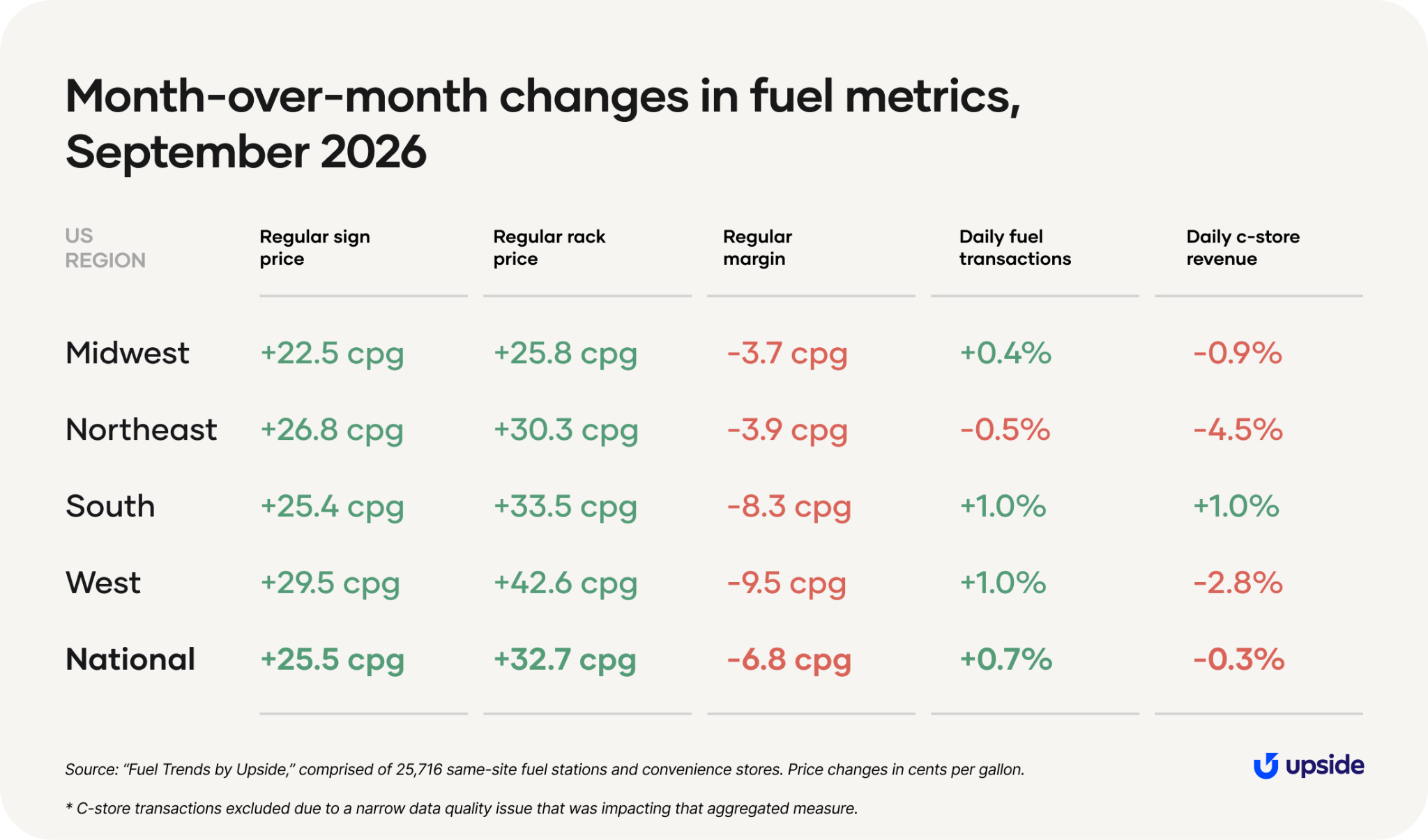
In August, we marked six months of fighting in the Middle East. September didn’t bring a de-escalation — quite the opposite, in fact. Flare-ups around the Persian Gulf and Red Sea further tightened the global supply of oil, leading to downstream price increases in wholesale and retail gasoline.
Rack prices at the average U.S. gas station rose 32.7 cents per gallon of regular in the month of September. Since this is driven by global trends, all U.S. regions were affected by the uptick.
Sign prices, meanwhile, did not rise as much as rack prices. On average, sign prices increased by 25.5 cents. With this discrepancy, the average margin decreased by about 7 cents per gallon — showing that retailers absorbed part of the burden of rising prices.
This is something we don’t usually expect to see in September. As we mentioned above, prices tend to go down this time of year due to lower seasonal demand and the switchover to cheaper winter-blend fuel. In September 2025, for example, prices were steady and margins ticked upwards. But as we’ve said many times in 2026, this hasn’t been an ordinary year.
Increasing demand (or at least, what appears to be increasing demand) is another example. Due to rising sign prices, fuel transactions went up at the typical station by 0.7%, on average. But again, this is a bit misleading. As gas gets more expensive, consumers visit stations more frequently, buying fewer gallons with each visit. Overall volume stays roughly constant.
Inside the store, revenue declined slightly in September, in line with predictable seasonal effects.
The other reason prices are high: Global refinery capacity
There was a lot of attention in September to the factors impacting the global oil supply, but that is only half the story behind rising fuel prices.
The other half is a story of global refinery capacity. While this story most acutely affects truckers, farmers, and anyone else who buys diesel, it has wider implications for the entire economy.
Over the past few weeks, we’ve seen more crude oil passing through the Strait of Hormuz. But the same can’t be said for refined product.
This is true for a few different reasons. First, many refineries around the Persian Gulf have been damaged by war, reducing capacity in the region. Second, amid ongoing fighting, refined product carries additional risks for exporters. By design, it ignites more easily than crude oil, which is a problem in a war zone. Finally, continued Ukrainian attacks on Russian refineries have led President Vladimir Putin to pause all diesel exports, further restricting the global supply.
Together, these factors have led to higher prices in the United States, especially for diesel. In September, the average U.S. station sold diesel for $6.17 per gallon, reaching an all-time daily record of $6.53 per gallon late in the month. Overall, a gallon of diesel is up $2.72 since the start of the war, an increase that dwarfs other grades of gas.
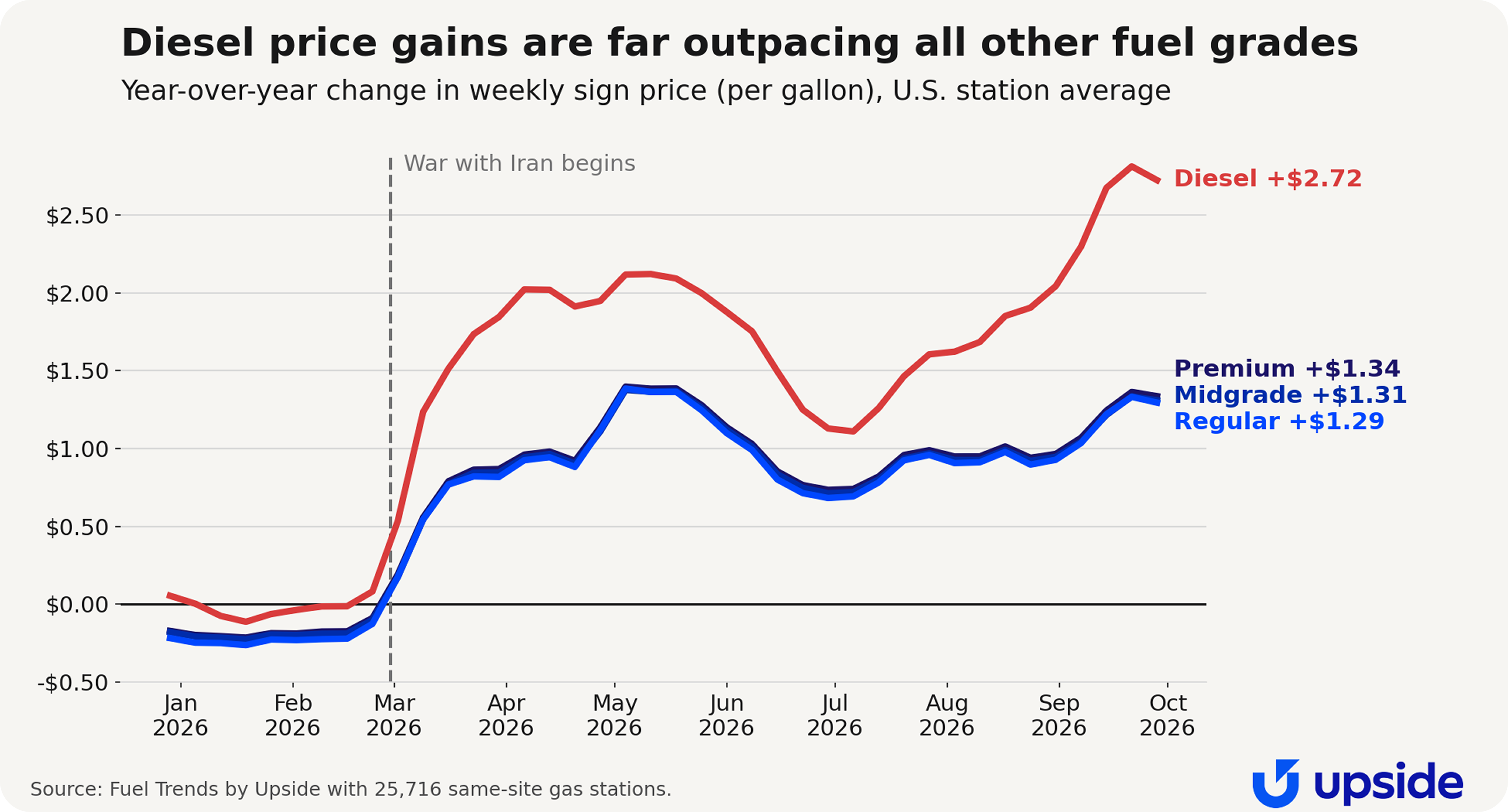
Stateside refining capacity hasn’t been affected by war, though — and in fact, it’s been at record levels as of late. So, why can’t we make up the difference?
Refined products like diesel are still a global commodity and subject to global supply and demand. Although the U.S. is producing more diesel, we have also exported more of it to help meet global demand. That means this period has been a boom for American exporters along the Gulf, who can now supply both domestic and international customers.
But these trends have also impacted retailers in the region.
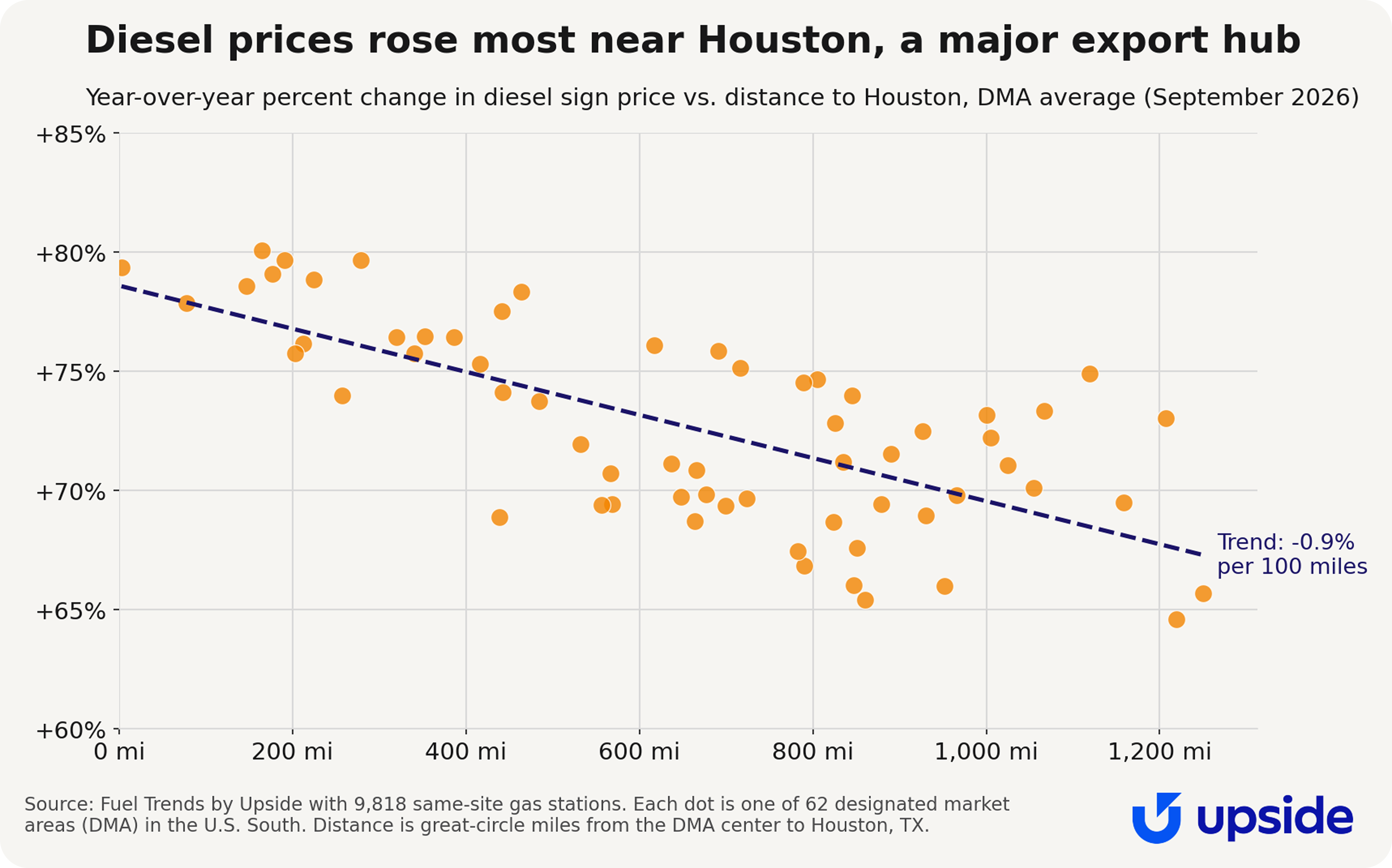
Consider, for example, the Port of Houston, which is the busiest port in America by tonnage. Since it is located on the Gulf near many large fuel refineries, it has become one of the largest exporting hubs for diesel fuel in the country.
This means gas stations and truck stops in the area have new competition for refined fuel: the rest of the world. And it’s driving up sign prices for them.
The chart below shows this impact. Gas stations closest to Houston have seen a larger percent increase in diesel sign prices than gas stations farther away from the port. On average, the year-over-year percent change in diesel sign price is about 1% lower for every 100 miles farther away a Southern gas station is from Houston.
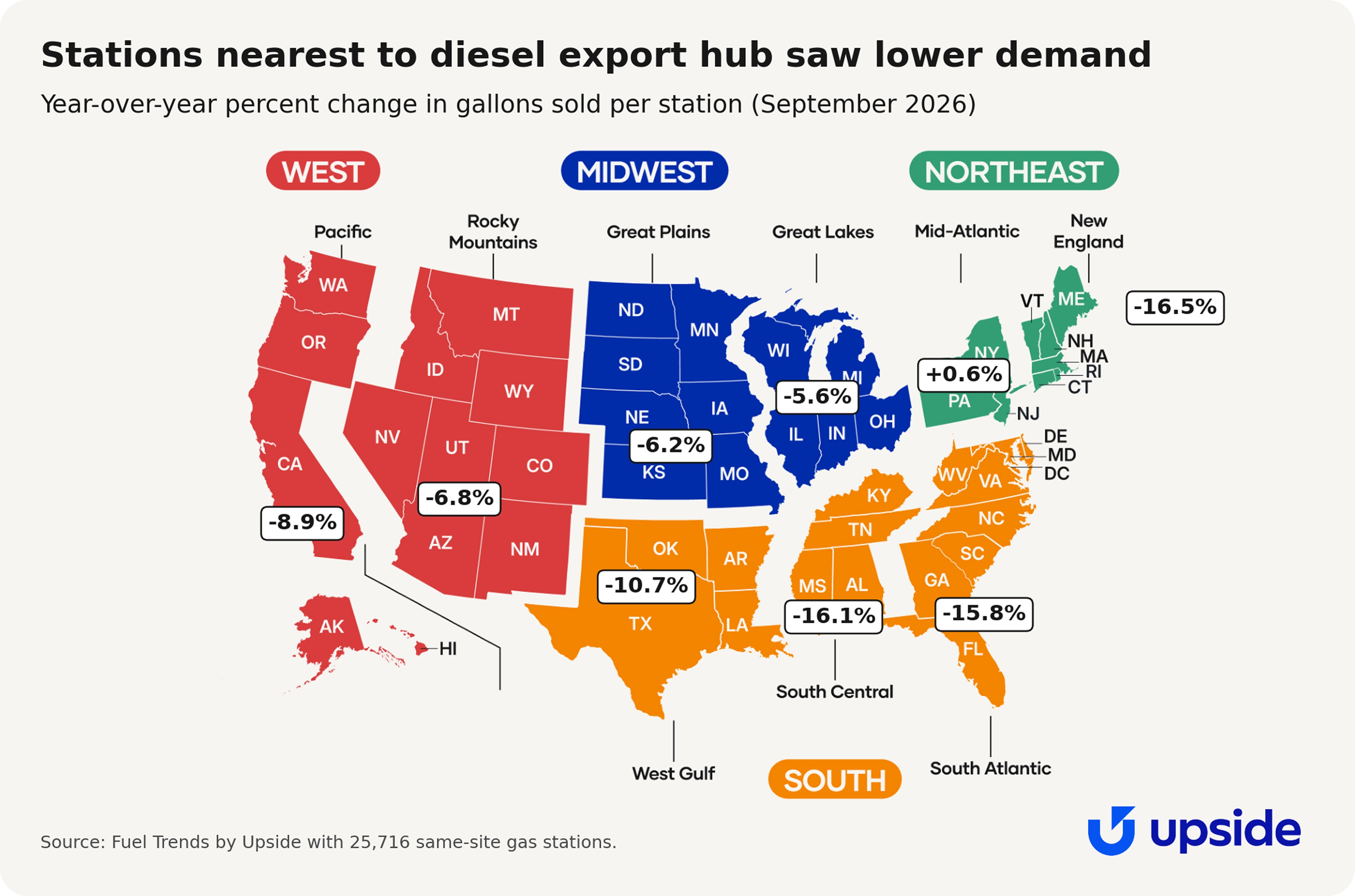
And this isn't just impacting sign prices, but overall volume too. Stations closest to the Gulf have seen steeper declines in diesel demand relative to the national average. (An important caveat here: The majority of Upside's partners are traditional gas stations, not truck stops, so this does not fully reflect overall change in diesel demand or how drivers shift from smaller-format stations to larger-format stations.)
Earlier this month, the American administration flirted with a diesel export ban, requiring American companies to keep their refined product within the States. Would that have solved the problem?
Most likely not, for two reasons. First, the global fuel supply is already low, and the market is tightly connected across borders. Banning the export of diesel fuel only decreases the global supply further.
Second, banning diesel exports can have the unintended effect of raising gasoline prices. When refineries process a barrel of oil, they produce both diesel and gasoline as an output. Right now, American companies are exporting diesel because domestic supply is greater than domestic demand. If we cut off exports, we'll have far more diesel than we need in the U.S., which will fill up limited storage capacity.
If that were to occur, and refineries couldn’t sell all of the diesel they were producing, they would cut back on their production. That means less gasoline, too, driving up that cost in the process.
Instead of a diesel export ban, President Trump has instead promoted tax-exempt red-dyed diesel on the roads as a way to bring down cost pressure.
Predictions and considerations
Another month, more of the same?
The message isn’t changing here; even as fall gets underway, we’re still talking about the same things we first surfaced in the spring. So we’ll keep it brief: We are still very much in the midst of a fuel supply crisis, and the only thing that will ease it is a full, permanent re-opening of the Strait of Hormuz.
Potential (other) tailwinds:
1. “Super El Niño” warming of the sea surface temperature is making it harder for hurricanes to form over the Atlantic Ocean. The warmer temperatures could lower demand for heating oil this winter. That would in turn ease seasonal pressure on diesel, which is chemically very similar to heating oil.
2. A patchwork of renewed fuel tax holidays will provide partial relief to drivers in those regions.
Potential (other) headwinds:
1. As the weather gets colder, demand both inside the store and out at the forecourt tends to fall. Even if the transaction count increases due to high prices, volume might not follow suit.
Subscribe to our monthly fuel trends updates




Request a demo
Request a demo of our platform with no obligation. Our team of industry experts will reach out to learn more about your unique business needs.


