




What we cover

Winning a restaurant customer’s first visit takes real effort. You have to build awareness, establish trust, and deliver on the diner’s expectations.
But keeping that customer is even harder. Our data shows that 64% of new restaurant customers don’t come back after their first month.
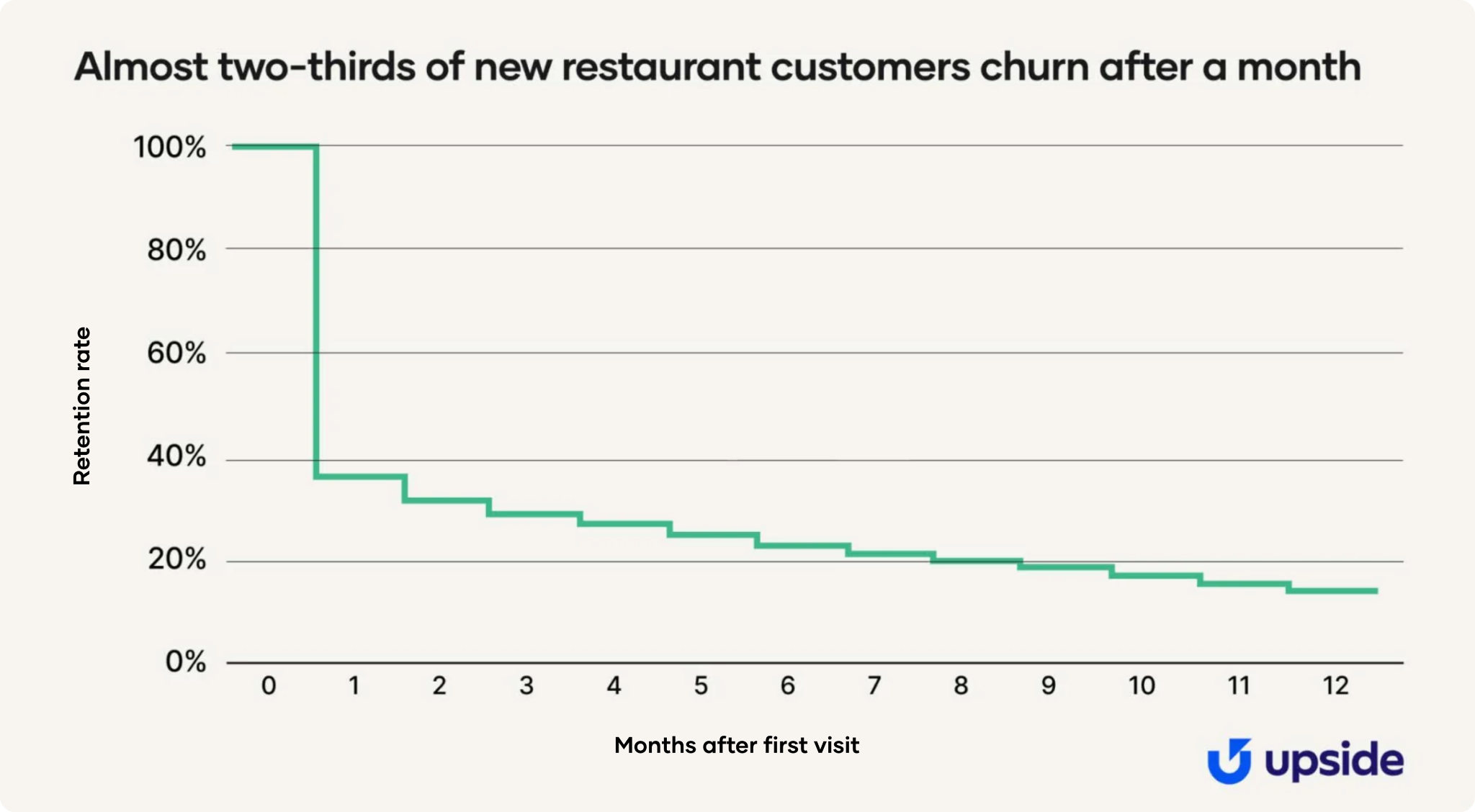
The steepest drop happens early. After the first month, retention declines in much smaller waves as diners make more visits. That makes the move from a first visit to a second the most important conversion in the customer lifecycle. While it’s an ongoing battle to keep a regular coming back, the most critical challenge is turning a first-timer into one.
The diners who do come back tell a different story. Among your regular customers, 56% will still be customers a year later, 39 points higher than new customers. Each visit makes the next one more likely, and habits compound from there.
Marketing builds awareness, but not habits
In our most recent survey of restaurant operators, 33% said they increased their marketing budgets since 2025, and 31% ran more campaigns. On the other hand, only 14% cut back.
That investment builds awareness and brings in new customers. But marketing alone doesn't reinforce behavior in the moments that matter most. A campaign rarely gives customers a reason to come back for a second trip.
Loyalty programs are built to fill that gap, but they can only influence diners who join, and a first-time guest may not have signed up yet. And even those who are part of a loyalty program are likely to be disengaged — only 38% of loyalty members told us that they use their programs often. There’s a considerable gap between the number of customers who say they value loyalty programs and the ones who actually use them consistently.
Marketing gets diners in the door once, and loyalty rewards the ones who already come back. The second visit falls in between.
How to win the second visit
To win a first-time visitor back for a second trip, operators should treat the customer's first month as their window. If most churn happens in the first 30 days, a win-back campaign that launches at 90 days may be aimed at someone who moved on two months ago. Build your follow-up around the first few weeks instead.
Second, track repeat visits, not just first ones. How many new customers come back, and how quickly? That number tells you more about future growth than one-time traffic does.
Finally, reach customers where they decide. Uncommitted diners choose where to eat on their phones, often within two hours of a meal, and usually outside your owned channels. A timely, relevant reason to return in that moment can turn a first visit into a second.
The case for one more visit
When there's little room left to raise prices, growth comes from visits. Most of your customers are uncommitted. They decide late, on their phones, and often outside your loyalty program. And new customers decide quickly whether to come back at all.
You don't need to turn every occasional diner into a regular. Rather, small steps add up. Our analysis shows that one more visit every two months from your uncommitted customers would increase revenue by 105%.
That's where Upside comes in. Our digital marketplace connects restaurants with nearby diners through personalized cash-back offers, reaching customers outside your owned channels in the moments they decide where to eat — and helping you win the second visit.
Upside helps retailers to accomplish each of the tactics that win a second visit. Here’s how:
- Right place, right time, right offer: Upside puts your restaurant on the same map where customers do their everyday errands, like filling up their tank and buying their groceries. Seeing your restaurant becomes part of their routine right as they’re deciding where to go. Each customer gets a personalized offer, so you’re not funding a one-size-fits-all offer for everyone. The result is net-new profit for your business.
- The data to make smart decisions: In the Upside Dashboard, restaurant operators can measure and track the behavior of each customer who claims an offer. Understand when they’re visiting, the offer amount that influences them, and how their habits changed due to Upside.
- Reaching the diners who respond most: In our retention analysis, infrequent customers who used Upside were 9.3 percentage points more likely to keep returning. That's the largest lift of any customer group, and larger than the 6.4-point lift among customers entirely new to a restaurant. The diners most responsive to a personalized offer are the ones current tactics reach least.
- Working alongside loyalty: Your program performs well for enrolled, engaged members. Upside layers on top of your existing loyalty and marketing investments to reach the diners a members-only channel can't.
Winning the uncommitted customer is not a complete and instantaneous transformation, but rather an ongoing effort. Win one more visit, then another, establishing habits over time. It’s a slow and steady process, but it’s the surest way to sustainable growth.
Get the full picture
Download Upside’s latest report, The uncommitted majority, for the complete analysis, including why the second visit is the highest-stakes moment for your business and how to build habits that last.


Request a demo
Request a demo of our platform with no obligation. Our team of industry experts will reach out to learn more about your unique business needs.


