




What we cover

Think about why your customers choose your grocery store. Maybe they love your selection of high-quality products. Maybe your prices give them the right value for their money. Maybe your employees are quick to smile and eager to help.
You invest in all of this to build an in-store experience your customers appreciate. But one factor often outweighs the rest: your store's location.
According to a report from Access Development, the average consumer travels only eight minutes from home to their grocery store.
So how do you earn business from shoppers outside that radius? Here's what the data shows.
What shapes customer travel patterns for cash-back incentives
The psychology behind cash-back shopping behavior
Cash-back offers can change how people shop. Earning cash back on everyday purchases, like groceries, often motivates shoppers to travel farther than they normally would. It's a straightforward exchange: a small reward for a little extra effort, and it's often enough to reshape someone's regular routine.
For many customers, the appeal isn't complicated. Getting cash back on a purchase they were already going to make feels like a smart use of their money.
What is the power of proximity?
For everyday purchases, like filling up a gas tank, getting a haircut, or catching a movie, consumers are sensitive to distance. Distance creates friction: it's the reason a shopper might pass over one retailer in favor of another closer to home.
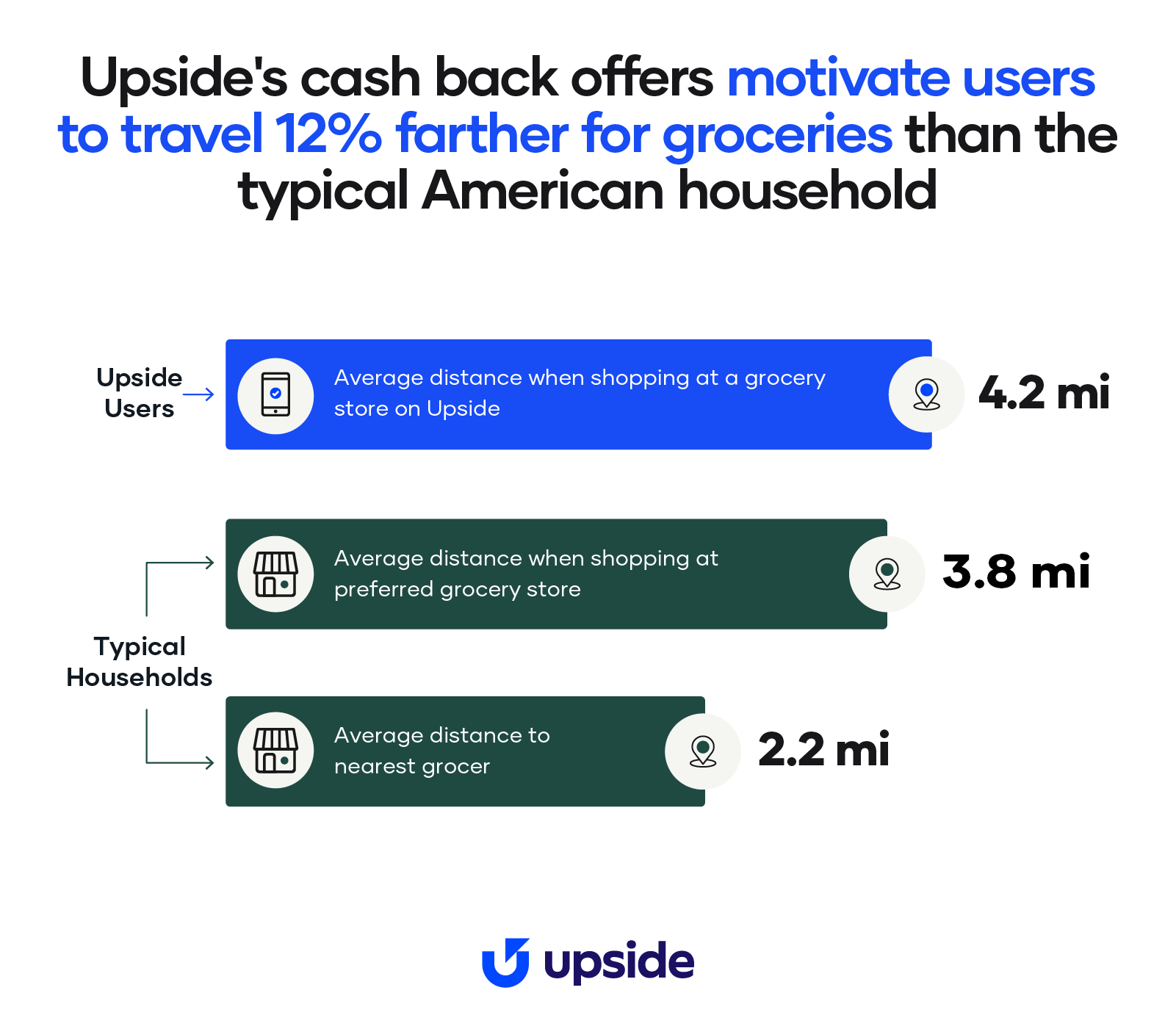
Grocery shopping works the same way. According to a USDA report, the average American's preferred grocery store, the one they visit most, sits about 3.8 miles from home. Their closest grocery store is even nearer, at 2.2 miles away on average.
Distance isn't the only factor, though. Price, selection, and service all shape where someone chooses to shop, which means you have more than one way to win over customers who live farther away. One of the most effective is a well-sized cash-back offer that makes the extra distance worth it. Restaurant customers respond to cash back the same way, traveling farther when the offer is worth the trip.
Customers will travel for cash back
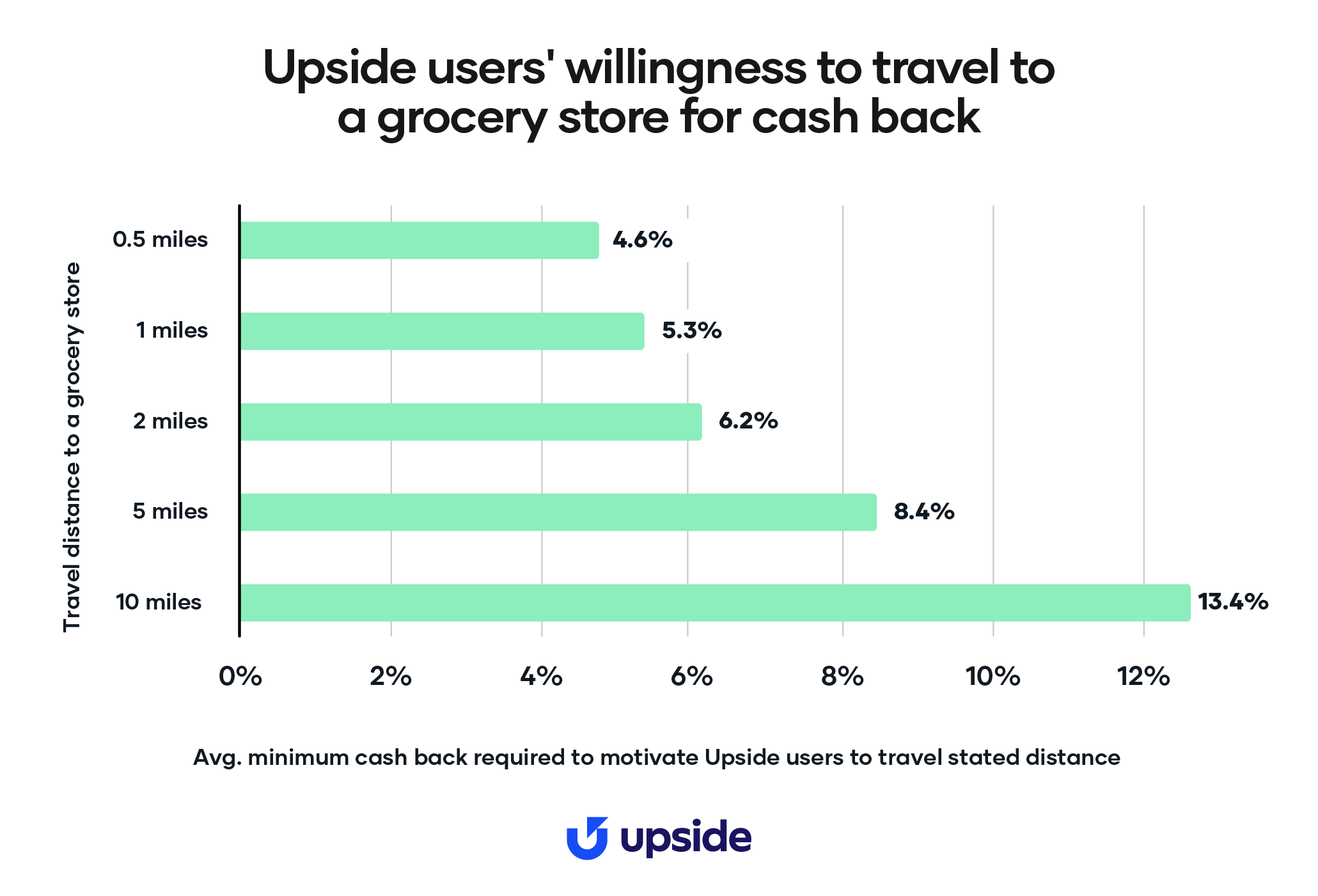
New data from Upside shows shoppers are willing to change their routine to earn cash back. On average, shoppers in this survey said they'd expect 5.3% cash back to travel one extra mile to a grocery store. With the right offer, some shoppers will travel as far as 10 miles.
How much cash back is the right amount?
At what point does an offer become unprofitable? As the distance to your store grows, so does the size of the offer a shopper expects.
Offers change behavior. But an offer that isn't personalized to the individual shopper can eat into the profit you'd have earned anyway.
Personalization is what sets Upside apart. Upside finds the offer amount most likely to bring a new customer through your doors, or convince an existing customer to spend more while they're there. Every offer is personalized to the individual, and every resulting transaction is new to your business, which means you keep the profit it brings in.
The average Upside user travels 4.2 miles for groceries, excluding outliers. Compare that to the 3.8 miles the typical household travels to its primary grocery store, and Upside's promotions are motivating users to travel 12% farther than they otherwise would.
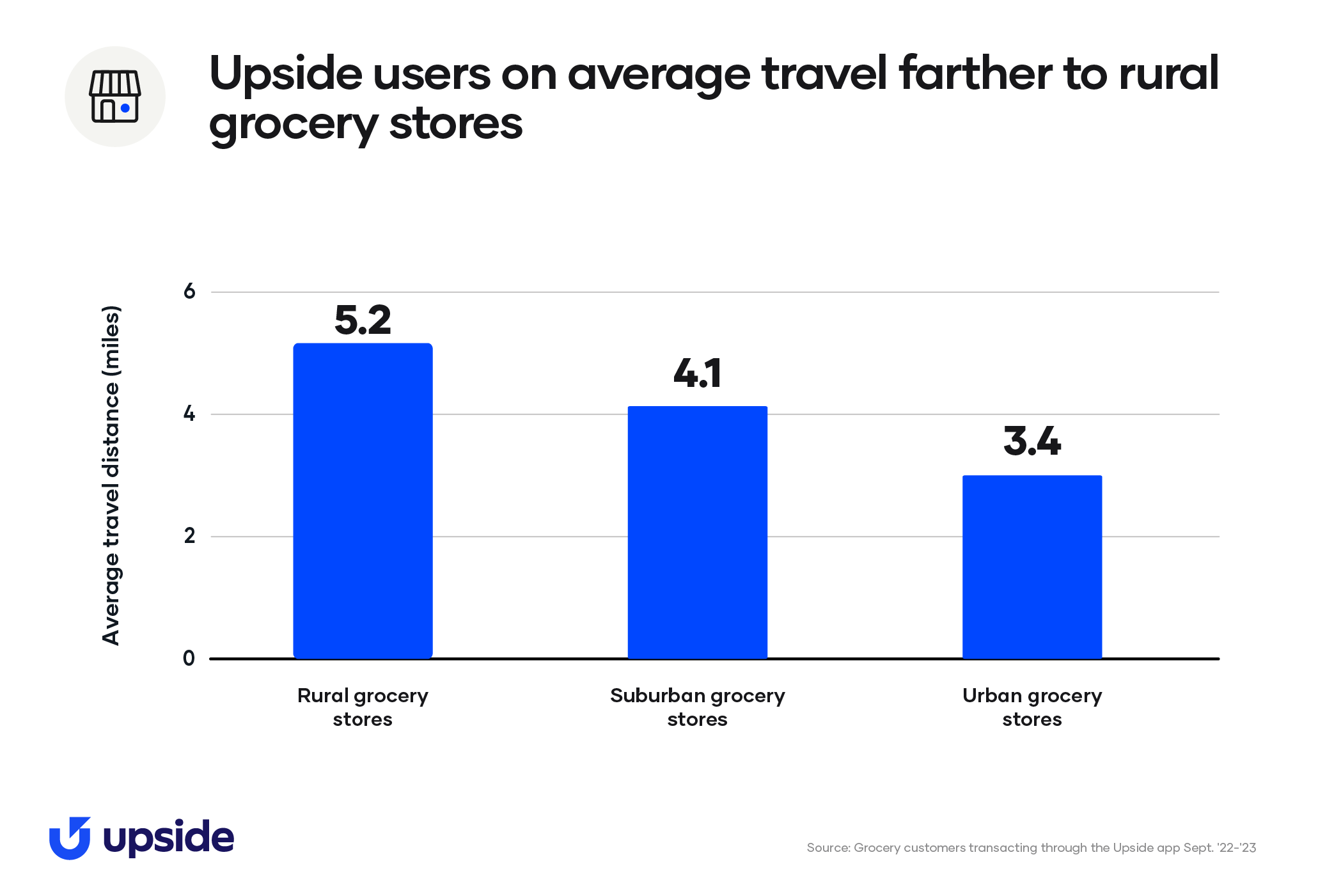
For rural consumers, that effect is even more pronounced: Upside users there travel an average of 5.2 miles for groceries.
Every one of these offers is profitable for you. That precision comes from real-time data: each shopper's history, plus dozens of other factors, shaping an offer that's actually worth their trip, without cutting into your margin. See how Upside's marketplace builds each offer.
Factors that influence customer travel distance for grocery cash-back offers
Cash-back percentage vs. travel costs
The relationship between an offer's size and the cost of getting there matters. A strong enough cash-back percentage can justify extra travel, but rising fuel prices or public transportation costs can cancel out that advantage if the offer isn't sized correctly.
Competition and market saturation
Market saturation shapes travel behavior too. Where there are a lot of nearby stores, competition is fierce, and shoppers have more choices close to home. That means they're less likely to travel far if a comparable offer is available nearby.
Convenience factors: store hours, parking, and accessibility
Convenience also factors into how far someone is willing to travel. Store hours that stretch beyond the usual nine-to-five make it easier for shoppers with non-traditional schedules to justify the trip. Extended hours, paired with a strong offer, can be enough to bring in shoppers who'd otherwise stay closer to home.
Is it worth getting customers to travel farther?
The average customer either isn't willing to go out of their way to shop with you, or they're already driving past your store for value elsewhere.
If you're looking to change that, advertising or delivery are the usual answers. Advertising can drive clicks and views, but it's rarely tied to a measurable change in shopper behavior. Delivery fees, meanwhile, are often too high to produce a positive return.
The real question is this: does it cost more to bring in customers from farther away than what they'll spend once they're in your store? The data says it's worth it, and it's profitable. Upside's measurement methodology is built to prove that for your stores specifically, not just as an industry average.
Upside extends your reach by miles, bringing in more customers and encouraging bigger baskets at checkout. Many Upside users are driving past their nearest grocery store, and even their usual store, to shop with participating retailers instead. Each new transaction, or each dollar of increased spend from an existing customer, adds incremental profit, even when it comes with a larger cash-back offer.
Upside users go the distance
In a competitive market, you need to reach beyond your immediate radius to bring in shoppers, and Upside helps you do it in a way that's measurable and profitable. Schedule a demo to see what that could look like for your stores.



Request a demo
Request a demo of our platform with no obligation. Our team of industry experts will reach out to learn more about your unique business needs.


