




What we cover

Global conflicts often trigger rapid swings in oil markets, which can quickly translate into higher prices at the pump. While those price changes tend to dominate headlines, the more interesting story often lies in how consumers and fuel retailers respond once prices begin to move.
Looking at recent fuel market disruptions — like the presently-escalating conflict in the Middle East — several consistent patterns emerge in how both drivers and retailers adapt during periods of price volatility.
Price shocks can ripple quickly
Fuel markets are closely tied to global crude oil prices, which means geopolitical events can influence gasoline prices in a matter of days.
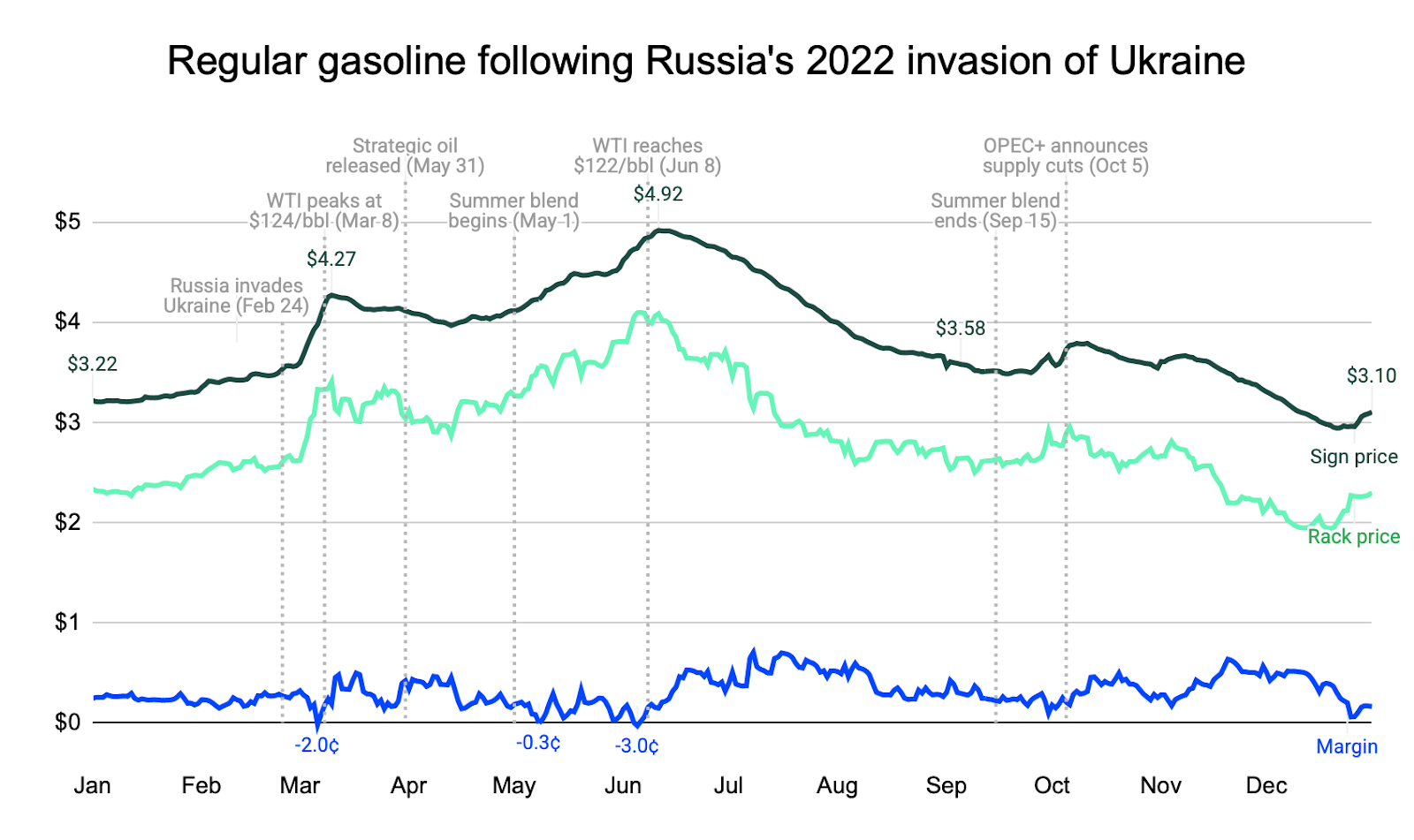
The most dramatic shock to gas prices in recent memory occurred when Russia invaded Ukraine in February 2022. Following the invasion, the initial market response was surprisingly muted. Sign prices increased just six cents over the first five days following, from $3.53 to $3.59 per gallon. But the calm wouldn't last.
Everything changed when the United States announced sanctions on oil imports from Russia. Two weeks after the invasion, West Texas Intermediate crude hit $123.64 per barrel on March 8, translating to $2.94 per gallon before any refining or retail markup. Average U.S. gasoline prices climbed by nearly 50 cents to an all-time high of $4.10 per gallon.
Retailers get hit first, and higher sign prices don’t always alleviate the pain
When gasoline prices climb, public attention often focuses on the impact to drivers. But fuel retailers often bear the brunt of rising prices before consumers fully see them at the pump.
Gas stations purchase fuel at wholesale “rack prices,” which reflect rapidly changing market conditions. When rack prices rise faster than stations can update their sign prices, margins get reduced.
Why don’t retailers just pass through their cost increases quicker? Raising sign prices is a delicate game, because fuel is an ultra-competitive industry. For many American consumers, the price is the only differentiator between the station on their left and the one on their right. Change prices too much or too quickly, and the retailer might lose customers. For that reason, retailers tend to phase in sign price adjustments slowly and gradually.
During the early weeks following the Ukraine invasion in 2022, wholesale prices rose quickly enough that average margins briefly turned negative for some stations. Retailers were literally losing money on every gallon sold, caught between rapidly rising wholesale costs and their reluctance to shock customers with instant price increases.
Drivers tend to buy less — and think harder about prices
When gasoline prices spike, drivers rarely stop buying fuel entirely. Instead, they tend to adjust their behavior in smaller ways.
One of the clearest changes appears in how much fuel consumers purchase during each visit. In early 2022, the average fuel transaction in February was about 11.1 gallons per visit. As prices climbed and eventually peaked in June, the typical transaction size declined to 10.2 gallons.
That shift suggests many drivers were stretching purchases slightly — perhaps filling up a little less frequently or adding smaller amounts of fuel each time they stopped at the pump.
Periods of elevated fuel prices also tend to make consumers more attentive to price differences between stations.
When prices rise quickly, drivers are more likely to compare options before choosing where to fill up. Even small price differences between stations can become more meaningful when overall fuel costs are elevated.
Generally, higher prices often make consumers more intentional about where they buy fuel.
Lessons from the summer of 2025
The June 2025 Israel–Iran conflict offers a useful comparison. Despite lasting 12 days and involving U.S. strikes on Iranian nuclear facilities, fuel markets barely moved.
Crude oil prices rose about 10% in the first six days of the conflict. In 2022, during the early weeks of Russia’s invasion of Ukraine, prices jumped roughly 33% over a similar period. Pump prices told a similar story: in 2025, the national average rose just eight cents per gallon. In 2022, it climbed $1.38.
Why the difference?
Market conditions mattered more than the severity of the conflict itself. In 2022, global energy markets were already under strain from pandemic recovery and refinery utilization was running around 94%. By 2025, supply chains had stabilized and the market had more capacity to absorb shocks.
That context helps explain the muted reaction. Iran sits along the Strait of Hormuz, a passage that carries roughly 20% of global oil supply — theoretically a much bigger risk than Russian disruption. But because markets were in a healthier position, prices barely reacted.
What this means for future fuel disruptions
Looking across previous fuel crises, a few patterns show up consistently.
One of the earliest signals comes from driver behavior. When people sense prices may be rising, they often fill up sooner than planned. In our data, fuel purchases sometimes jump more than 10% before prices at the pump move — often a day or two in advance.
At the same time, pressure builds behind the scenes for retailers. Stations buy fuel at wholesale prices before selling it at the pump. When those costs rise quickly, stations can end up paying more for fuel while still charging the old price on their sign. As that gap widens — sometimes reaching about 45 cents per gallon — stations typically have little choice but to raise their pump prices.
With the ability to analyze billions of retail transactions, Upside can uniquely analyze both sides of the fuel marketplace. In our Fuel Trends series, we publish regular updates with data from the largest single dashboard of industry data in America today.
Subscribe for the most in-depth look at dozens of industry metrics, every single month.



Request a demo
Request a demo of our platform with no obligation. Our team of industry experts will reach out to learn more about your unique business needs.


